How Moonshot Compost + Moonshot Organics turn transparent data and discarded organics into cleaner soils—and tomorrow’s fuels.
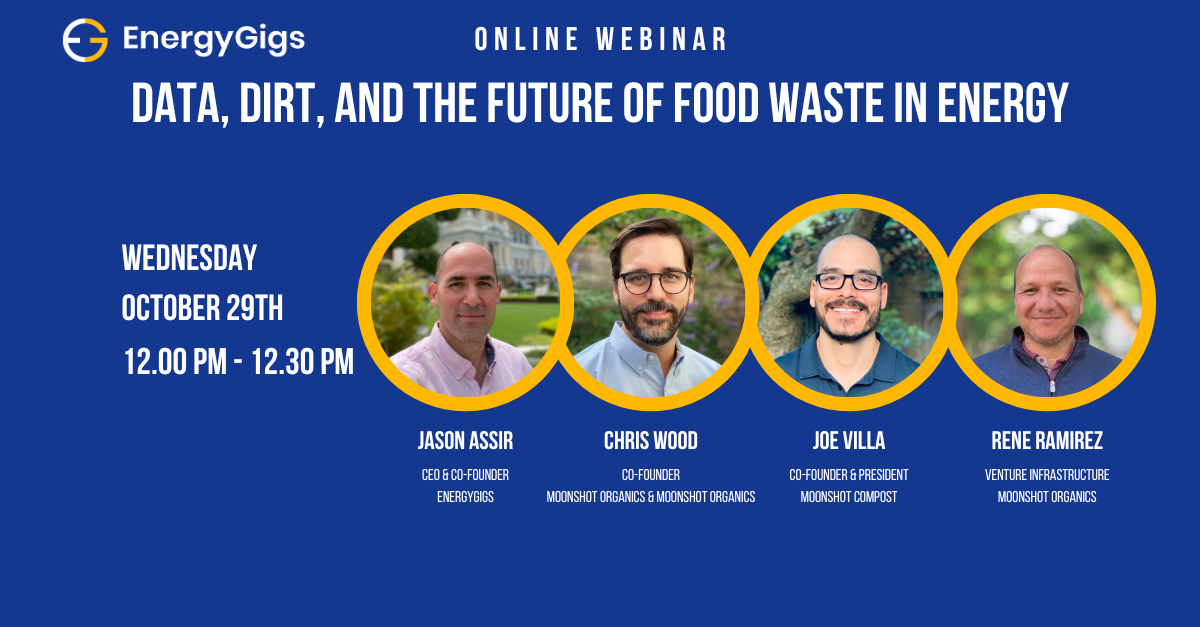
What if every banana peel told a story? In this month’s EnergyGigs webinar, CEO Jason Assir sits down with Chris Wood (Moonshot Compost and Moonshot Organics), Joe Villa (Moonshot Compost), and Rene Ramirez (Moonshot Organics) to unpack a simple idea with big consequences: when you track organics like a supply chain, you unlock better operations, measurable sustainability, and new energy pathways.
Watch the Webinar:
Transcript:
Jason Assir
I would like to welcome everyone to this, this this month’s webinar. We’re super excited. We’ve got some special guests today. The topic of today is data dirt and the future of food waste. On this webinar we’ve got Chris Wood, co founder of Joe Villa, co founder of Moonshot Compost. And we also have Rene Ramirez who’s co founder of Moonshot Organics. It is super exciting day for, for me guys. I’ve, I’ve, I’ve known you guys for a while and, and, and I love the things that you’re building and the companies that you, you know, you put together and the sort of ecosystem that you’ve, you’ve created. So very excited to have you on. Real quick, before we get into the topic at hand, what is Energy Gig? So Energy Gigs is a freelance platform for the energy industry. We connect energy companies to just in time talent. So you can find recent retirees, you can find job seekers, you can find consultants to help you work on projects on a just in time basis. Hourly projects, temp to perm. We have a payment rail to 178 different countries. So it’s your source for just in time. But before let’s get into the topic. So data Dirt in the future of food waste. Guys, so excited to have you. Thank you so much for joining. Maybe let’s start off with like, how did this start? What’s the origin story here of, of the companies?
Chris Wood
Thanks, Jason. I, I’ll start with Moonshot Compost because it came first in line and in some ways it’s kind of my fault. I had been a lawyer for 16 years and my wife and I were expecting our second child and she was also a corporate lawyer. And we realized that one of us needed to be in a different career path so we could have more time to be parents. And I foolishly thought that a startup would give me more time. But when, when we started looking for business opportunities as a family, I realized that Apple, Amazon and Google knew everything about my life but nothing about my trash can. There was just no data on that. And that was interesting to me. And when I started researching what was in my trash, I realized that food waste was incredibly valuable and was underutilized, at least in where I lived in Houston, Texas. And I started trying to figure out how to move it around as a total novice and was reaching out to my brother in law, Joe Villa. We’re married to sisters and Joe was in business development and the transportation industry. And I honestly had no idea what those words meant. In that order. But from talking to him at holidays when we were together as a family, I was like, I think he can help. So I started emailing Joe from WeWork saying, how do I move things around Joe?
Joe Villa
I thought he was bored, to be honest, y’. All. I knew he had already taken a little hiatus from his current attorney or legal role. I thought he was just bored. But at the same time, I knew.
Chris Wood
He was a smart guy and I.
Joe Villa
Knew there was a little bit of substance behind the question. And of course, I’d give them the best answer that I could. I was in bd, but I. I was still pretty aware with supply chain and moving, you know, material or commodities around, but never, never around food waste or, you know, anything related. But it did, you know, spark an interest, you know, because it being Chris and, and understanding that there was a little thought behind that, but.
Chris Wood
And it takes a lot of luck, right? And so we were doing some research, and we saw that the U.S. composting Council had a seminar upcoming that fall of 2019 on how to operate a large scale industrial compost facility. And it was in Denton, Texas, just north of Dallas, where Joe lived. And I was too trepidatious to go alone. And I asked Joe if he’d go with me since he had been helping me do the research. And honestly, we still have relationships with people who are in the room that day. And we would get together and drink wine at night and talk about what we had learned during the day. And we realized that we didn’t have the capital necessary to start compost facilities, but we had done some research. And it’s always scary when people say, I’ve researched this on the Internet. But we had found some really important reporting that had been put together. And there was an opportunity in Texas to connect compost facilities with people who wanted to divert food waste. And so we went from fall of 2019, continuing to do research. We committed in February of 2020. And then I don’t know if any of y’ all remember Covid, but that happened. We decided not to shuttle our plans and we went ahead and launched in July 2020, that first summer of COVID business called Moonshot Compost to help Houstonians divert food waste. And we knew that we wanted to fail big, we didn’t want to succeed small. And so as soon as we could, we went to Austin. As soon as we could, we went to Dallas. And so today our footprint includes serving predominantly commercial subscribers in Houston, Austin, Dallas, and Waco, Texas. We do have a residential portion of our business in Houston that we’re real proud of as well.
Jason Assir
Wonderful. And then, so, Renee, like, how did. How did you get synced up with Chris and Joe? What was the. What happened there?
Rene Ramirez
Like, yeah, well, you know, I happen to live in a very lucky street. Chris actually lives down the street from me, and we had met a couple times. We were just kind of discussing commodities. My background’s at commodity trading. I was a power trader for 22 years before I kind of retired off and started doing other stuff in sustainability. And Chris was a big part of that. You know, he introduced me about moonshot compost comp. The idea of moonshot compost, because it was still very early on, and it was. It was still a very much growing company. And thinking about it, I was like, wow, I really love what they’re doing. But it was like, how do we expand beyond that? And that was a big aspect of it. So with that, I went ahead and got my venture infrastructure hat on and started investing in research in Purdue to kind of convert that food waste Chris and Joe are collecting into energy in the form of hydrogen and ethanol.
Chris Wood
Wow.
Jason Assir
And this was like. Was this when the IRA came out? Like, what’s. What’s the timeframe when that. When you guys started working together?
Rene Ramirez
Like, what, man, it’s been a while now. Would you say 2022, Chris?
Chris Wood
Yeah, it’s funny. I was going to say April. April of 2021 was the date. I was. It’s funny. It really is a family business. Right. So my wife had met Renee professionally, and I think my wife has always been a little curious about what Joe and I were up to. And she said, hey, Renee seems like a smart guy. You should talk to him way wrong way. Yeah. Well, she didn’t really know Renee well at that point. But it’s funny, I remember we went to a La Madeleine in our neighborhood and had coffee, and Whether it was 2021 or 2022, we’ve literally talked every day since then. It feels like. And it’s been a very collaborative effort. And I know we’re on a podcast, you know, talking about sort of like, the benefits of networking and how to. How to find roles. It’s really astounding how many people you have in your network that may have common goals and aspirations that you do. And I hate to say it, we just always had a deck ready. So people, we’d be introduced to folks, and we’d say, let’s meet for coffee and let’s talk about what we’re trying to do. And data has always Been huge part of Moonshot’s journey. 1. It was part of my inspiration personally, but Joe, I think, had that same inclination that I did. And so it’s part of our DNA. We both have had corporate backgrounds our whole lives, and we didn’t want to start another recycling company where people were like, I wonder what happens once I give them this food waste? Right? There’s just a lot of uncertainty around recycling right now, an industry. And whether you’re a business or a person, you’re like, what happens to this stream that I’m creating? I put stuff in a green trash can or I put it in a large open top behind my business. Where does it go next? And so we were connected through an old colleague of mine in the energy space to Jason and his team. And we’ve been working on a data reporting platform since the very beginning. I mean, six months in, and we had no idea what we were doing, but we were confident that we could meet the right people to help us figure it out. And so our vision has been the driving force. But we would not be where we are today without conversations with people like Renee, without conversations and informal arrangements with people like Jason and his team. And it’s really astounding. I mean, we know exactly how much food waste we’ve moved around. You know, we’re. We’re over £12 million of food waste that our subscribers have diverted since we’ve launched, and we’re growing the rate of diversion every week, and we track all that and report it back to all our subscribers. But that vision, to help make sure that people understand how much food waste they’re diverting from the landfill and what the environmental impact of that diversion is, really guides all of our decision making. We don’t go to a new city, we don’t hire new drivers or get new trucks unless we make sure that what we’re doing is in support of relaying back to our subscribers the way they’re changing the communities where they live through better decision making. And we don’t think we can do any of that without data. So everything we do is creating, maintain, and reporting good data back to our subscribers. And more recently, we’ve created a website where we’ve turned our business inside out. We report that data to everybody, but we think it’s really important to. To help people understand the nature of the problem and the nature of the solution.
Jason Assir
That’s. That’s awesome. I mean, I think a question maybe for some of the viewers and for any of the people attending, please do ask questions in the chat. Happy to, to, to, to bring. Bring your questions into, into the discussion. But what does that mean in sort of real terms, like on a customer basis? Like, what is, what is data in and compost? Like, what is, what are we talking about, guys? Like, what does that look like? What does it sound like?
Joe Villa
I’ll take the first swing at this. You know, in our space, and we realized this early on, there were sustainability efforts made by the chief sustainability officer, sustainability directors. In my corporate past Life, in the 10K report, you would see maybe a sentence, I say this quite often, or two sentences in the very bottom paragraph of what they were starting to move or what they were going to try to accomplish in their sustainability efforts or goals. We realized there was a role already starting to evolve and the data would be important to help promote the good that they’re doing and the efforts and what it actually means. So teaming up with your team, Jason early on, it was quite refreshing to hear Chris and I describe what we were wanting and what we were hoping that would tell the story for our well, for Moonshot as well, and for our partners. To be able to promote what they’ve diverted and what it means to the environment was a big step to help the sustainability directors, managers, anybody on that team, wherever our partners were, really flex and really show that this is a thing and it really isn’t that hard. It is a scary thing because it is dirty. It is, as you, as you said, data and the dirt that’s involved, it is dirty when what we do, but we promote it with a dashboard that is telling the story in a clean way. And it helps them. It really helps them promote, like I mentioned, the good that they’re doing. And hopefully at their quarter review, they get the bump in money that they deserve.
Chris Wood
So, yeah, so each one of our commercial subscribers gets a diversion dashboard, we call it, which is a single page for every location where we’re collecting their food waste that reports how many pounds of food waste they’ve diverted from that location. It has three tiles on it that have some equivalencies for the impact. Because what a lot of people don’t realize about food waste is that when it goes to the landfill, it gets covered up and all organic matter will break down. It breaks down without oxygen and it releases methane. So food waste is the largest category of anything in the landfill. It’s 24% of all landfill waste in America, and it’s the third largest source of greenhouse gases in America. So those three tiles on the diversion dashboard say, well, your food waste did not go to the landfill where methane was created. So we take that avoided methane emissions and give some equivalencies. So it’s as if a certain number of trees have drawn down CO2 for a year, or as if you’ve undriven this many miles or pulled this many pounds of carbon dioxide from the atmosphere. So right there on the diversion dashboard, you see how much you’ve diverted, what the impact is. And then we even have a last 12 months bar graph at the bottom showing how much food waste they’ve diverted for each month for the last 12 months. And one of the decisions we made early on is we don’t want this to be protected by a login and password accessible only by people in back offices. So each diversion dashboard is just a website. We hand out QR codes, and each of our customers can distribute those QR codes to internal and external stakeholders to show what they’re doing. And so it really does diversion dashboards just go out into the universe. And every one of our subscribers gets to decide how they want to share that and with whom. And we think that that sort of innovation to make all the data very public has been a really big part about our subscribers feeling comfortable working with us and maximizing the impact of the relations.
Rene Ramirez
One thing I’d like to add to that, and the data is important for a lot of reasons, but it sure is noble to, like, do good things and kind of keep it to yourself knowing that the right thing. But it’s hard to cause a movement without the information being out there.
Chris Wood
Good point.
Rene Ramirez
And it’s important to, like, have that data, have that information to get that momentum behind not only you, but for other people that may not think about it. And, you know, I think good ideas are best out in the public and then at the same time, getting that momentum and getting that leadership that obviously Campos has done, but really made it important for everyone to say, hey, this is how I contribute. This is how I add value. And at the same time, that’s making other people do the same. And then now you actually have some momentum and movement and going the direction we want. Right. You don’t have to know where you’re going, but know the direction. And, you know, having that data behind us allows the direction to really be clear.
Jason Assir
And I mean, I think that’s. It’s. It’s almost like a. I wouldn’t say radical transparency, but it’s. It’s a real. I mean, it’s really impressive to be so transparent with your data. I mean, what’s it been like in the market in terms of when you’ve started presenting the data, like, what have your customers? Both. I know you serve both commercial customers and residential customers. Like, what’s that been like? In terms of what? Like, has that opened doors for you guys in terms of work more customers.
Joe Villa
And yeah, I think early on, early on, you know, that was kind of our go to Jason just to be able to promote there is recording tool. Nothing was really out there at the time, or at least not what we found on Google at the time of us doing our searches or our own research. But it really has helped us get our foot in the door because it was something that wasn’t provided before and people were requesting. What does it mean? You know, people were usually reporting maybe some volume conversion and it was usually sent to them in a spreadsheet. And that was early decisions by Chris and I to say, what does that actually mean? We don’t have a data analyst at the time to be able to tell us, okay, you’ve diverted £10,000. What does that actually mean? So being able to add the dashboard really kind of set the tone to be able to promote.
Chris Wood
I think it’s interesting too to talk about how it happened. So we were. One of our first commercial subscribers was Rice University. And I started at that, by the way. We started at a pilot program at two of their cafeterias and then expanded very quickly to the rest of their cafeterias. And we developed the diversion dashboard and had it designed and then it was delivered to us. And then we realized, oh no, we have to be the ones to put the. I mean, like we just step by step kept seeing the obstacles on how hard it is to weigh every drum as we’re collecting them to put that weight into some sort of automated system so that all the drivers have to do is with a scale. Take our 55 gallon drums, put it on the scale, type the weight in, and then our technology has to do the rest. And so our technology pulls that into our proprietary data system. We have a database in aws and then once a week we’re pushing the data from our database into all these dashboards we’ve created. So once we created it for Rice and we didn’t even charge them for it, we started shopping it to other subscribers to say, would you be interested in this? And I think the aha moment for Joe and I is that when we were having conversations with potential customers and again, Covid, we had masks on. They had masks on. It was a very strange time. Most of the questions during A site visit would be about operations. Oh, this is going to be hard. Why are you using drums? Oh, this is so different. As soon as we came to the site visit with the diversion dashboard, they quit asking questions about the ops. They’re like, tell me more about this dashboard. And so what we learned through that is people want to tell a story. People want to be kind of the hero of their own journey. And the dashboard was a way for them to visually see that. If I’m going to ask my team to take these efforts from a facilities or operations side, if I’m going to ask my management team to divert this budget, or if I’m a solo business owner, I’m going to divert my own money to this man. I can tell people about it. So, I mean, this is a service that we charge for on the dashboard side commercially. But I think the principal benefit to us is that it really aligns us with our customers where they understand exactly the good that they’re doing and it. And they’re able to derive from that what they need to. To justify the program. And so for us, we can’t imagine having grown as fast as we have without that data component. I mean, it really goes hand in hand. Now we have to be operationally excellent, and we could talk a lot about how hard and important that is, but it is kind of exciting from our perspective to see that it really is the data that changed the types of conversations we were having and really open doors to new types of customers.
Jason Assir
Awesome. That’s great. So it looks like we got a good question from Catherine. Catherine, thank you for the question. I’ve been curious about the dashboard. Do you measure each individual’s pickup? Do you have a scale on the pickup vehicle, or is it done at the truck level? It’s getting into. Into the.
Joe Villa
Into the weeds.
Jason Assir
Yeah.
Joe Villa
Into the dirt.
Jason Assir
Yeah.
Joe Villa
Yeah. Well, I think, as Chris mentioned.
Chris Wood
Yeah.
Joe Villa
Truck, whether it’s residential or commercial, does have a scale. And it is just the contents. We subtract the weight of the containers or the bins, drums. So it is just the contents of the organics that’s being promoted or at least shown on the dashboard.
Jason Assir
Oh, that’s great. And I think what would be good to maybe talk through now is. So it sounds like there was a. You saw there maybe there was a gap in the marketplace with regard to the supply chain and moving organic waste to the composting facility. But then. So what’s the handoff to the moonshot organics? Like, what. What is that? Like, what does that look like? For you guys?
Chris Wood
Yeah. And I want to. Renee, before you jump into the tech, I kind of want to set the table about food waste a little bit. It’s almost impossible to have the right mental image for how much food waste there is every year. So it’s 100 year in America of food waste, and that is just so much. Composting is an amazing solution for food waste. You know, we take the food waste we collect to a composting facility, they mix it in the appropriate ratio with plant waste, and then they apply time, water, and special processes. So this natural, organic process that the earth has developed as a solution for organic waste for billions of years happens. And I want to emphasize how efficient it is. It is very difficult to invent a technology that is as efficient as composting. That said, with 130 billion pounds a year of food waste, we need more than just composting as a solution. You can’t have enough compost facilities. You know, like, at the scale of these compost facilities, they’re 100 acres each. That’s very expensive near city centers. So they’re all outside the city, ringing the city. If we were to get all the food waste in the city of Houston, we think that’s like £5 million a day. That would overwhelm the composting infrastructure. It would take forever to build enough composting infrastructure. So at no point do we think we should replace composting. It’s amazing. We need compost. There’s a soil problem in America, and compost is part of that solution. But we need other technologies to attack different parts of the food waste supply chain. And that’s where I think Renee’s research and finding the technology at Purdue becomes very interesting because it’s. It’s additive to the solution. It’s not taking away from composting, but it’s creating another type of solution that helps us get to all the food waste that’s not being tackled, because right now, 90% of that food waste is going to the landfill. So we need more solutions.
Jason Assir
That’s great.
Rene Ramirez
Nailed it, Chris. I think that’s exactly the big part of it is, like, we needed more solutions, and we wanted more effective and just honestly, better solutions than we had presently outside of composting. I mean, like I said, composting is amazing, but the other options are, like I said, landfill or take it to an RNG facility. And I kind of thought there might be something better. And a big aspect of what we’re doing is how can we process this waste to leave really Nothing. And moonshot organics allows for that, which was really critical and at the same time doesn’t create the emissions that some other technologies do. Right. Obviously, renewable natural gas is a great opportunity and great option. I think all options are needed, like Chris had mentioned. At the same time, though, we like the idea of, hey, how about get this waste and eliminate it at the same time, bring value, clean value to the surrounding communities. And that’s what’s a big aspect of moonshot organics. We can get that food waste process, it turn into clean burning hydrogen or clean burning ethanol and have nothing in the back end, which is critical. And honestly, I think it stands alone.
Chris Wood
Well, nothing. Nothing in terms of waste. But what does come out the back end is material that’s not just suitable, but very useful for agricultural purposes and then clean water. So we kind of have a stack of technologies where we’re able to take that food waste, extract the valuable fuel that’s more green than natural gas, and then to have the agricultural product. So when you. When we’re deploying the agricultural product appropriately, the water appropriately, it is kind of a zero waste process. And there’s no emissions in that process as well. And so we feel like it competes very favorably for some of the other mechanisms that are out there. Renee, I think it might be useful. Why don’t you talk a little bit about anaerobic digestion and what it is and what it’s trying to do and the place it has in the marketplace right now?
Rene Ramirez
No, absolutely. Biggest non composting solution to food waste right now is an anaerobic digester, which is basically a big tank that you put in a bunch of bugs, you know, obviously some bacteria or some sort of little bug that’ll go ahead and break down that food waste and create methane from it. A typical anaerobic Digester takes about 22 days to create methane. And on the back end, they have a bunch of dead bugs and this kind of slurry that they call digestive, and then they have to get rid of that. You know, some states are totally against just putting in a land application. There’s conversation that it is kind of a soil amendment, which is definitely debatable in a lot of ways. At the same time, it’s hard to haul it around. So we’re looking for a better solution. And our solution takes roughly 24 hours to turn into hydrogen compared to 22 days. And it doesn’t have that digestive. That is really just a big problem. And RNG is standalone because it does take a lot of LCFS credits, which those are low carbon fuel standards in California and rents credits. And basically it is a large program to allow for incentives to get back to these producers of RNG. Give you an example, natural gas is roughly 3 bucks BTU right now, 4, depending, I guess we’re getting towards winter months. So let’s say for RNG goes to roughly 30. And it’s not because it burns any better. It’s only because it is laden with a lot of incentives that are basically, governments are trying to push this. This direction. At the same time, it creates more methane. So with our technology, we can feel positive IR without any incentives at all.
Jason Assir
That’s wonderful. I mean, it. I mean, and just the partnership that you guys have of these two companies working together of tackling food waste and also tackling an energy. You know, the energy shortages that we have across the country is wonderful. I know we’re almost at time, so if anyone else had any additional questions, please do. This time has already fl. But I did have a question sort of on the talent side of the house and then another one on. On technology. Maybe starting off with technology, like, what are y’ all seeing in terms of technology investments and like, in your business with regard to, like, AI? Is that something that’s. That’s you’re incorporating in your business? Is that something that’s. That you find useful in the space? I know that there’s lots of startups around AI. Be curious to get your thoughts on that.
Chris Wood
Yeah, I mean, I think we’re statutorily required to say that we’re an AI business because that’s the only way to be interesting in the modern world. But I mean, at its core, we think of AI as sort of like it needs to be trained on good data. Right. And so we have started to think about what are the ways that the data that we have could be useful for other business purposes or to assist other haulers in creating estimates. So we’re definitely working with our data team to think about that. Ultimately, we have to create good data to train AI to create good estimates or projections. And so that’s interesting. And that’s something that we’re thinking about a lot. And I think for both moonshot compost and moonshot organics, there will be opportunities to use AI for storytelling purposes and for planning purposes.
Jason Assir
Okay, that’s good enough. And then just on the talent side of things, I mean, you guys are like truly a circular economy, you know, creating a circular business. What are you seeing on the talent side of things in terms of what are the types of profile of people that you, you. You hire, you know, what, you know, people that do well in sort of your business that you found like any, any trends that you noticed or anything you can speak to on. On the talent side?
Joe Villa
You know, that’s a. It’s a good question. You know, Chris, earlier, I guess maybe when we launched in Dallas, we started looking for the sustainability, sustainability manager or the sales BD person in our. In this DFW area. We kind of had an epiphany. We wanted to have somebody that was already familiar with sustainability, had already been involved in some type of recycling or some type of vertical along those lines where we could even learn from. You know, Chris and I are, you know, in our 50s, so it was good for us to understand. We still wanted to learn. We still wanted to learn from, you know, other people that were in our vertical. You know, as we’ve grown and been around other, you know, colleagues in our vertical, we’ve built a bit of a, you know, a network of people that are familiar with our space. So as we’re looking to fill a role in the Houston area, we have taken an approach to take our time and make sure we do find the right fit for this role. But it is, I think there is pool of talent of people that are wanting to be in this space. It’s starting to grow. We’re pretty happy with the team we build, especially in the markets that we’re in. They understand it, they’re able to communicate as a subject matter expert. But it does help when they are already familiar with what we’re building and what we’re.
Chris Wood
But we can help folks transition. You know, what I think is interesting is that everyone is a subject matter expert in something, and the number of people that are experts in food waste is very small. And so our job as an institution is to find people that are maybe adjacent to us and industries that give them kind of a working knowledge of what we do, but that do have some type of subject matter expertise that’s useful to us. And we’re hiring all the time. And everyone says that, but we literally are. We have like a third party to our lead who’s helping us, and we talk to this person multiple times a week. We’ve counted it up. We’ve hired 62 people since we’ve started, you know, including Joe, Renee and I at Moonshot Compost, and we’re a team of about 30 right now. So that’s about, you know, 50% turnover since we started. But when we compare our annual turnover rates to industry averages, we’re right at or just a little better than the industry average on turnover for both drivers and the non driver roles. And in this economy, the best you can hope for is to bring in really dynamic and interesting people, to train them to be useful to you and to learn from them and then to understand the very best people that you have are just going to be with you for a little while and then they’re going to go on to the next thing. And Joe and I feel like so long as we’re adding to them and they’re adding to us while they’re with us, it’s really dynamic and it’s awesome. And then when we go back into the marketplace, Moonshot is bigger, stronger and better and we’re able to hire kind of the next level up in terms of talent because of where we are. And so we’re always hiring, we’re always looking and we’re really looking for people that are going to teach us in some way and help us to, to learn something new that we haven’t known before.
Rene Ramirez
And Jason, I’ll, I’ll add a little something as well because obviously it’s a part of the name here.
Jason Assir
Yeah.
Rene Ramirez
You know, at least in the stuff I do, which is a lot more on the venture infrastructure side, we’ve been hiring mechanical engineers, we’re going to be looking at chemists, we’re going to be looking for electrical engineers and electricians. Like, we’re growing. Thankfully things are going well in our space, but we still got more, more growing to do. But then learning, you know, that, hey, everyone’s gonna bring different values. But the most important value that I have that when I’m looking to someone is someone’s passion, what they’re doing. Like, you know what, you could have got a fork every day of your life, but if you don’t, you’re not interested, interested in the actual job and you’re just there to get a paycheck. I’d rather not have you. I’d rather have someone that’s a, you know, 2.5 GPA, but like lives and breathes and they’ll be just fine and it’ll be exciting. Right? I mean, I think the other day we were sitting outside the shop and we had just had a successful run in one of our tests and we were just sitting out there and like, this is great, you know what I mean? And that’s the kind, that’s what I look for. And maybe I just, I really do enjoy what I do. But to be with people that really care about, about the job but also the industry, the direction we’re going and wanting to build something together. I think that you can’t ask for more than that.
Jason Assir
That’s awesome. Well I, I mean two very great mission driven organizations here. Moonshot Compost, Moonshot Organics. Guys, thank you so much for, for being on our webinar today. So for the attendees, like if you’re looking for work, maybe check out their websites. We’ll, we’ll include those in those show notes guys if that’s okay with you and maybe hopefully you get some more talented candidates coming your way. But anyways, thank you so much again guys. Really appreciate it and yeah, look forward to following your work on all the different channels that are out there and if you haven’t subscribed to Moonshot Compost, do so now.
Chris Wood
Thanks so much for the opportunity Jason. It’s been our pleasure. Thank you.
Jason Assir
Thanks guys. Take care. Thanks everyone.